
Do you ever wish your 3D prints had x22 times more mass? Has the lack of toxicity in your 3D prints been a source of consternation? If, for some strange reason, you answered “yes” to either of these questions then this could be the solution you’ve been looking for: Lost-PLA lead casting.
The literal “what, why, when, where & how’s” are covered on this page, but in essence, the aim is to take a 3D printed model and turn it in to lead. An overview of the rough process is as follows:
- Create the desired 3D print and set it in a casting medium – this experiment used general builders sand and some cement as a binder.
- Once cured, set the mould upside-down in a fire and melt all of the PLA plastic out.
- Melt a pot of lead and pour in to the new cavity left behind.
- Wait for the mould to cure and then break it out and clean up.
The Process
The design chosen was a simple heart shape, with the sprue jutting from the point to act as a ‘stand’. Within the heart is an embossing of the the elemental symbol and atomic number for lead: Pb-82.
This design was chosen because it consists of an easily recognisable symbol, with increasing levels of intricacy in the different sized text.
Feel free to interact with the model yourself!
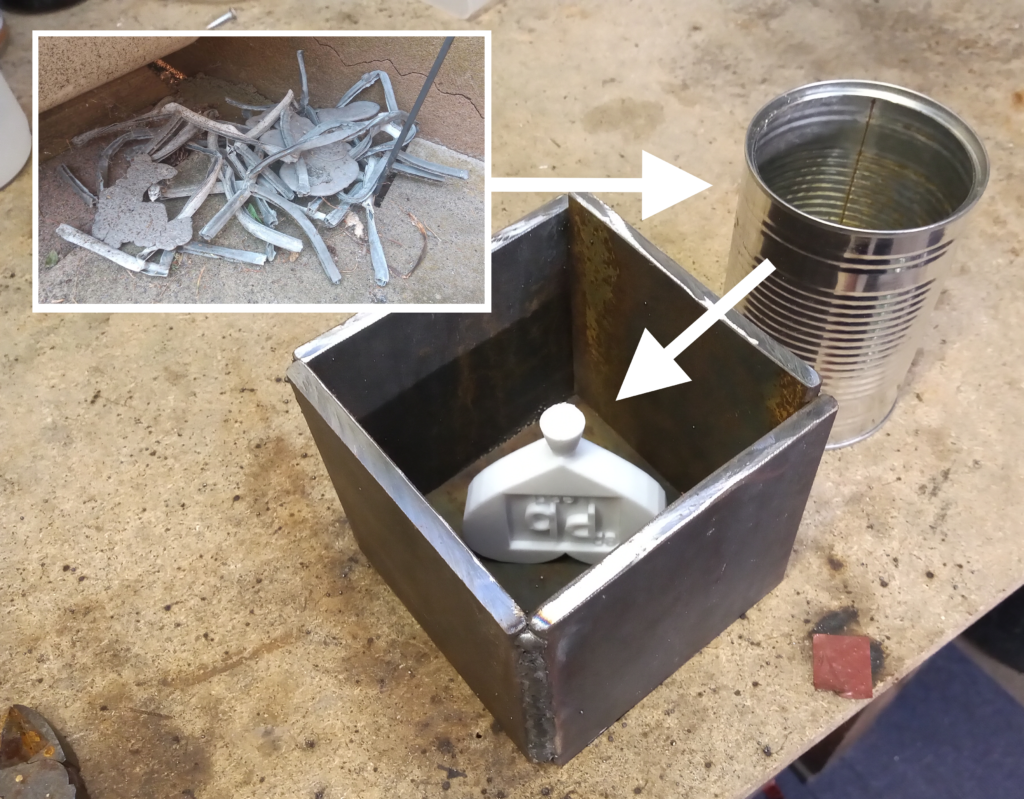
The casting process was done by suspending a bit of angle iron bolted to a modified baked bean tin over the edge of an incinerator bin while an inferno rages within the bin.
Once molten, the lead was poured in to the mould, and the left-over was poured into a Farrow’s giant marrowfat pea tin. Surprisingly simple.
As the liquid lead is more dense than any of the soot/ash/detritus that enters the can, the liquid pours out from below the flotilla of crud.
It’s worth noting that you should not pour lead onto water, as the water will immediately turn into steam, quickly expand, and shoot molten lead in all directions. This was learnt from experience so you don’t have to.

The final extraction process was significantly less simple, and required the use of angle grinders, hammers and misappropriated flat-headed screwdrivers.
In future, greater thought will be given to how the cast should be released from mould!


Results
While the overall outcome looks scraggy and unrefined, I’m honestly impressed by the results. The outline shape is well defined, and there are sections where you can even see the original lines from the 0.4mm nozzle on the 3D printer.
Admittedly the front of the model lacks any fidelity, and the inclusions make it impossible to clean the cementitious media from all of the nooks any crenulations. However, I believe this is likely due to the wrong casting media used.


For reference: mass of PLA model = 19g. Mass of the lead model = 433g!