Introduction
Preface
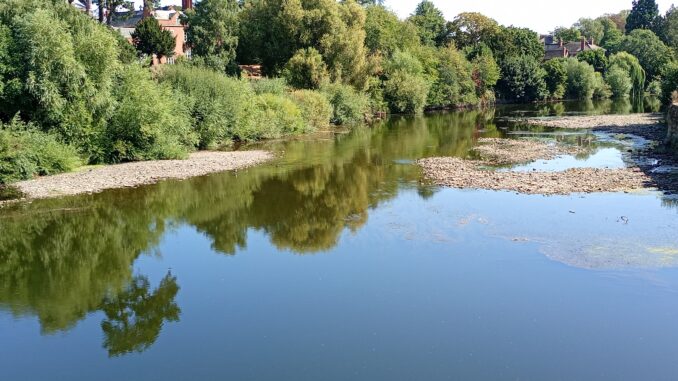
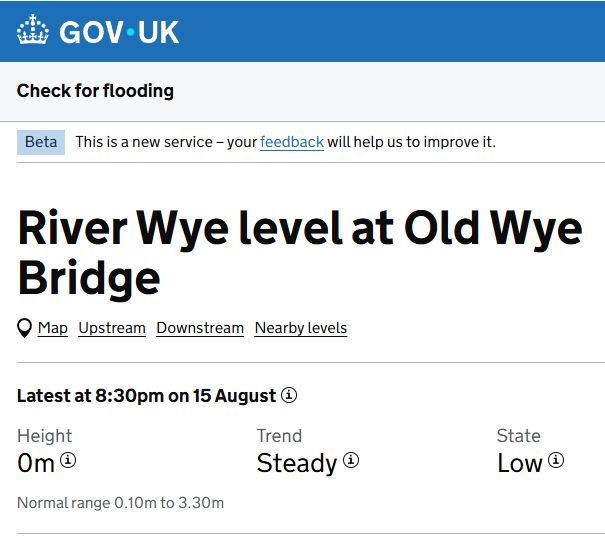
At the time of writing (August 2026), Herefordshire is suffering from a severe drought with only 1mm of recorded rainfall for the entire month of July (compared to the average of 50-60mm). As a result of this, the River Wye has receded so much that the monitoring station at the old bridge is reading a depth of 0 cm, and the river would be easily fordable by foot.
This got me thinking about the etymology of ‘Hereford’ as a place name, and where the name comes from. The ‘-ford’ suffix is pretty obvious as the river is evidentially fordable at the moment, and it’s not uncommon for the river to be traversable in the summer.
But what about the ‘Here-‘ prefix? Surely the city name simply means ‘a ford is here’? Apparently not.
Caveats
While I’ve invested a fair amount of time researching this subject and have included as many references as possible, it’s important to note that I’m not a historian.
The timeline focuses mostly on the middle ages which was over 1,000 years ago where there are few remaining primary sources of information. To confuse matters further, secondary sources of information are sometimes contradictory – and in some instances – outright fabrications.
During this time period, there were no established agreed standards for anything. Spellings depended on the original language and how the translator perceived them. Grammar didn’t really exist, and the dates vary depending on the scribe. Some used the Gregorian calendar, others the Julian calendar. Some considered the date of AD 0 to be the date of Jesus’ birth, others the date of his death.
The Current Anglo-Saxon Theory
According to “A Dictionary of British Place Names” by A.D Mills, the ‘here’ part of ‘Hereford’ comes from the Anglo-Saxon word for ‘army’. Therefore the place name ‘Hereford’ comes from a ‘ford suitable for the passage of an army’, or ‘army-ford’. [ref 2]
However, digging a bit deeper – it would seem that there were two Anglo-Saxon words for ‘army’. The first word being ‘here’, and the other word being ‘fyrd’. The difference in usage between the two words is whether the army was attacking or defending. [ref 3]
Due to the lack of military logistics in the dark ages, an attacking army would have to sustain itself upon the spoils of war, pillaging and plundering as it went along. The Anglo-Saxon word for pillage/plunder is ‘hergian’, which is where ‘here’ originated from. [ref 4]
In contrast, a ‘fyrd’ was often used to describe a defending army, with a ‘great fyrd’ consisting of all abled bodied men and whatever implements they could wield to defend the lord’s estate from a Viking raid. Alfred the Great (no relation to Alexander the Great) later reformed the fyrd and also introduced fortified settlements known as ‘burhs’ to defend against Danes. (The word ‘burh’ is where the modern word ‘borough’ comes from). [ref 5]
While many burhs such as Bath, Exeter, Southampton and Southward were built to defend against invading shallow-draught Viking longships travelling inland via the rivers, Hereford was not bestowed with this title. Regardless of this, the location on the river provided a natural geographical defensive position against the main threat of the time: The Welsh.
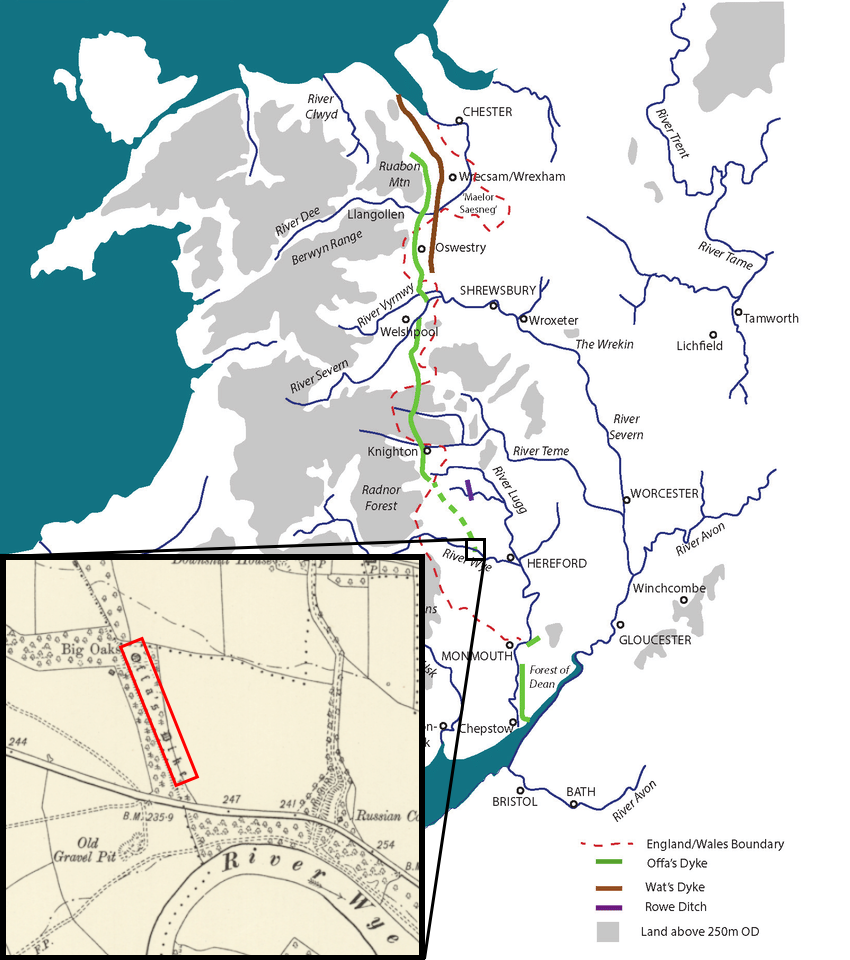
To counteract the constant threat of the Welsh, Offa’s dyke was constructed in the 8th century by King Offa of Mercia. This mighty defensive earthwork structure commences in North Wales, just west of Wrexham and continues down south to the River Wye and terminates east of Byford, therefore redirecting any invading Welsh forces southwards towards Hereford [see footnote]. [ref 6]
More evidence of Hereford’s defensive structures were uncovered during the construction of the inner-ring road in 1968. Excavations about half a mile west of Hereford Cathedral unearthed a defensive gravel rampart that dates between AD 750-1066, which lends more credence to Hereford being a significant defensive settlement. [ref 7]
The first written entry of ‘Hereford’ that appears in the Anglo-Saxon chronicles is within an entry in the Winchester Manuscript dated AD 918, “…a-plundering towards Archenfield. Then met them the men of Hereford and of Gloucester…“. The full text describes an enemy Viking ship sailing up the Severn estuary, capturing the Bishop of/in Archenfield [see footnote] and then ransoming the Bishop back to King Edward the Elder (no relation to Pitt the Elder). Before then continuing their campaign of aggression further inland, where the forces of Hereford and Gloucester successfully repelled them. [ref 8]
So, if Hereford was such an important defensive location, why would it be called ‘here-ford’, and not ‘fyrd-ford’?
Further analysing the Winchester Manuscript, it’s easy to see that the entry for the year AD 918 was unusually verbose – measuring approximately 374 words. This compares to a meagre 91 words to describe the activities of AD 917 (75% reduction), and a pitiful 57 words for the year AD 919. In both the entries for AD 918 and AD 919 there is a mention of the word ‘fyrd’, and the entry for AD 919 specifically uses ‘fyrd’ to describe offensive army, “King Edward fared with the fyrd to Bedford and got possession of the town…“.
Doing a quick CTRL+F search on the full translation of the Anglo-Saxon chronicles throws up the following stats:
- There are 686 instances of the word ‘here’, but these are all as an adverb to mean at a certain place/time, not as a noun to mean ‘army’.
- There are 8 instances of the word ‘army’ within the chronicles (with a further instance in the index).
- In comparison, there are 173 instances of the word ‘fyrd’ (with a further 6 instances in the introduction and index).
Given that the word ‘fyrd’ is used to describe an offensive army, and the word ‘army’ is used separately (and significantly less often), this casts more doubts on the origin of ‘Hereford’ as ‘army-ford’.
So where did the ‘here’ prefix really originate from?
Offering an Alternative Theory
I believe that the origins of the name ‘Hereford’ predates the Anglo-Saxons, and even predates the Romans. Although some examples of Roman roads can still be seen in modern infrastructure – namely the aptly named “Roman Road” – Hereford was never specifically under Roman control. The closest Roman settlement, Magnae Dobunnorum, was located in modern-day Kenchester, about 4.5 miles north-west of Hereford Cathedral, and many of the archaeological finds discovered in Hereford have been attributed to Kenchester. [ref 9]
Before the Roman occupation, the area was inhabited by the Celtic Britons, and there is a potential clue to origin of the name ‘Hereford’ on a road sign less than a mile south from the centre of Abergavenny on the A465, whereby there is a dual Welsh-English translation of, “Hereford Henffordd“. Bisecting the name ‘Henffordd’ into it’s constituent parts, ‘hen’ + ‘ffordd’, and translating them from Welsh to English yields, ‘old’ + ‘road’.
As Hereford is located at a the most southern viable fording point across the River Wye, it seems likely that any journeys that needed to cross the River Wye would converge at Hereford, thus forming a node along an old road. This road would have connected the iron age settlement at Credenhill Camp with Lodge Hill Ford and also the later Roman settlements at Magnae Dobunnorum and Caerleon.
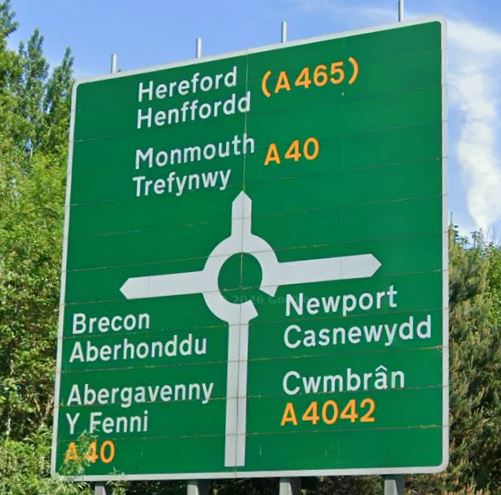
That solves 6 of the 8 letters: H e r e f o r d. But what about the other two letters, how did ‘Hen’ turn into ‘Here’?
At a similar time to the Anglo-Saxon Chronicles, there were scribes in the city of St Davids in Wales composing the ‘Annales Cambriae’, which is effectively the Welsh counterpart to the Anglo-Saxon Chronicles focussing on the events in the areas around Wales, Ireland, Cornwall, England and Scotland.
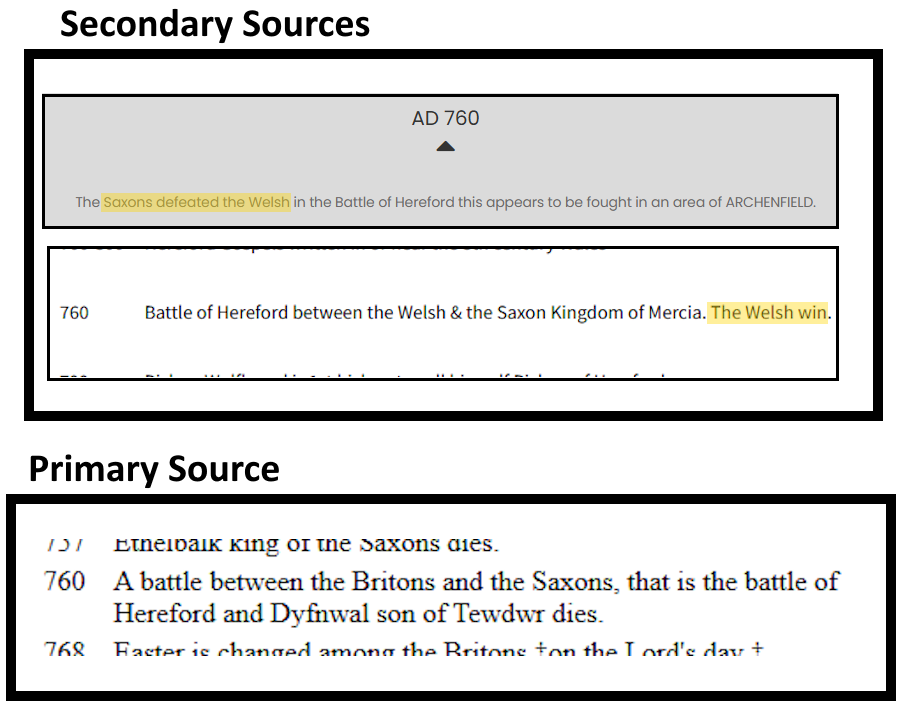
Within these texts lies an entry for AD 760 that reads “Bellum inter Brittones et Saxones, id est guieth Hirford, et Dunnagual filii Tedubr moritur.“, which translates from Latin to “War breaks out between the Britons and the Saxons, that is, the battle of Hereford, and Dunnagual, son of Tedubr, dies.” [ref 10]
Again, bisecting the word ‘Hirford’ obtains a prefix of ‘hir-‘, which translates from Old Welsh/Brittonic to English as ‘long’, and is pronounced as /hɪər/ (the same as the adverb ‘here’). Is it plausible that a ‘Here’ was transcribed as a mishearing of ‘hir’ and the origin of ‘Hereford’ means ‘long-road’?
There is a theory that the place name of ‘Hirford’ is complementary to the town of Burford near Tenbury, where the ‘Bur’ prefix comes from the a Welsh translation of ‘byr’ meaning short. [ref 11]. Given that the River Teme at Burford is a about 13 metres from bank to bank, and the Wye at Hereford is 55 metres from bank to bank, the categorisation of ‘long’ and ‘short’ does work for our modern day definition of ‘ford’, but without having access to Brittonic maps, it’s difficult to ascertain if the actual road was longer or shorter.
Conclusion:
Honestly, after spending the last two weeks researching this topic, I’m more confused than when I started, and without access to the primary sources of evidence it’s impossible to provide a conclusion with any certainty.
However, my take-away from this project is that while the modern day spelling and pronunciation of ‘Hereford’ might date from the Anglo-Saxon period, the origin of the place name is significantly older and is not a translation of the Old-English word for ‘army’.
I believe that the origin of ‘Hereford’ as the place name comes from the Brittonic Celts that roamed the lands before the Roman invasion, and I would postulate that they were describing a geologically advantageous point that was essential on their travel routes (be it for trade or tirade), and this colloquial name was carried down generations solely as a spoken word, as literacy was reserved for the nobility and clergy.
I would continue my speculation that the area later became a strategic military point, and as the population increased to a point where the place name was first recorded, the Anglo-Saxon scribe used the spelling ‘here’ instead of ‘hir’, and this spelling was then mispronounced with the additional syllable.
I did some research into the cadence of old English and if it was spoken with a lilt which may explain the additional syllable, but unfortunately due to the lack of recording equipment at the time, that knowledge is lost to time [ref 15].
Footnotes:
While delving down the various rabbit holes of discovery, I came across a few tangential items of interest that felt worth mentioning.
Fords & Dykes
The termination of Offa’s Dyke to the east of the ford at Byford makes geographical sense: if any invading Welsh forces crossed the river at Byford, they would still be on the wrong side of the dyke, as you can see on the map below.
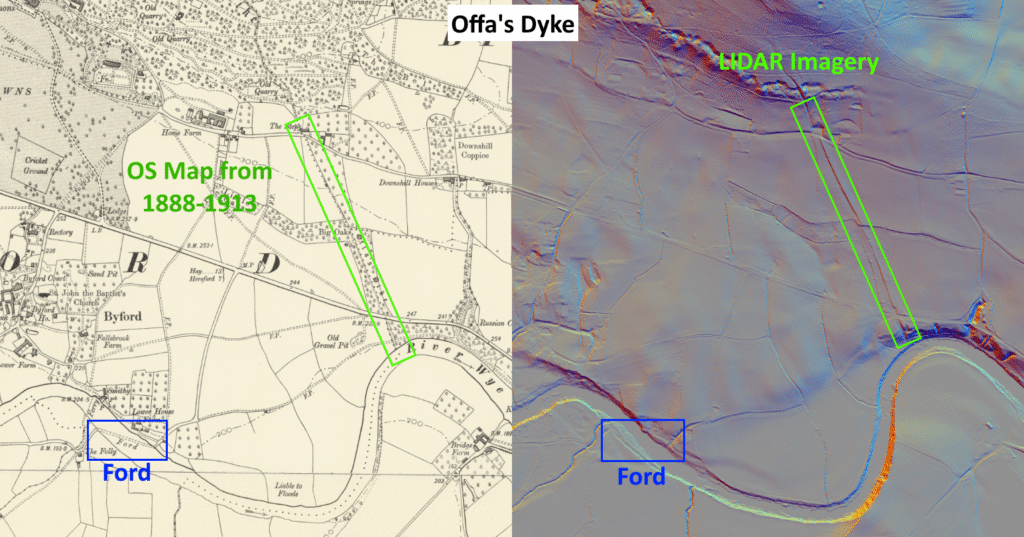
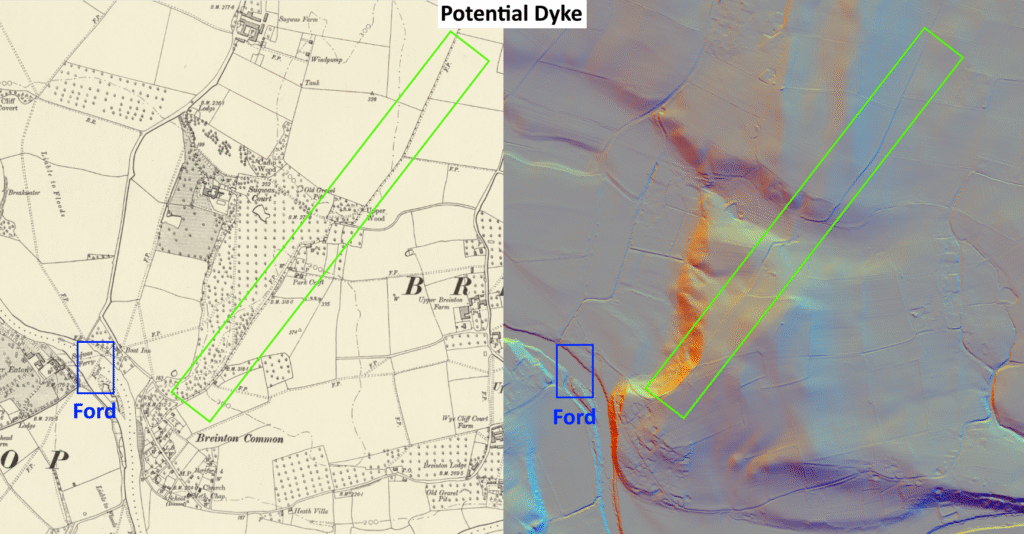
However, Byford is not the final fording point before the ford at Hereford: there is a crossing point at Breinton, and more interestingly, LIDAR imagery of the area seems to show a similar type of earth work structure west of the ford – I can’t help but wonder if this is an ancient defensive structure.
Old Kingdoms
Following the withdrawal of the Romans, many smaller kingdoms developed. One such kingdom was ‘Ergyng’ which encompassed an area spanning from Ross-on-Wye to Hay-on-Wye, and it even has it’s own modern independence group [ref 13].
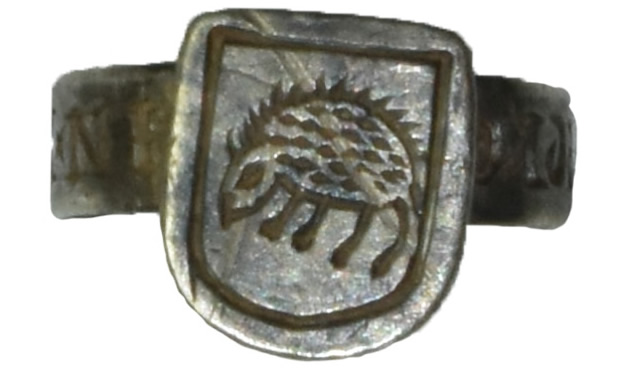
The area was important enough to warrant having a bishop and also featured in the Anglo-Saxon chronicles under the modern name of ‘Archenfield’. Interestingly, the etymology of ‘Archenfield’ goes back to ‘urchin field’, whereby an ‘urchin’ was an old name given to a hedgehog – giving rise to the town emblem of Ross-on-Wye.
The River Wye
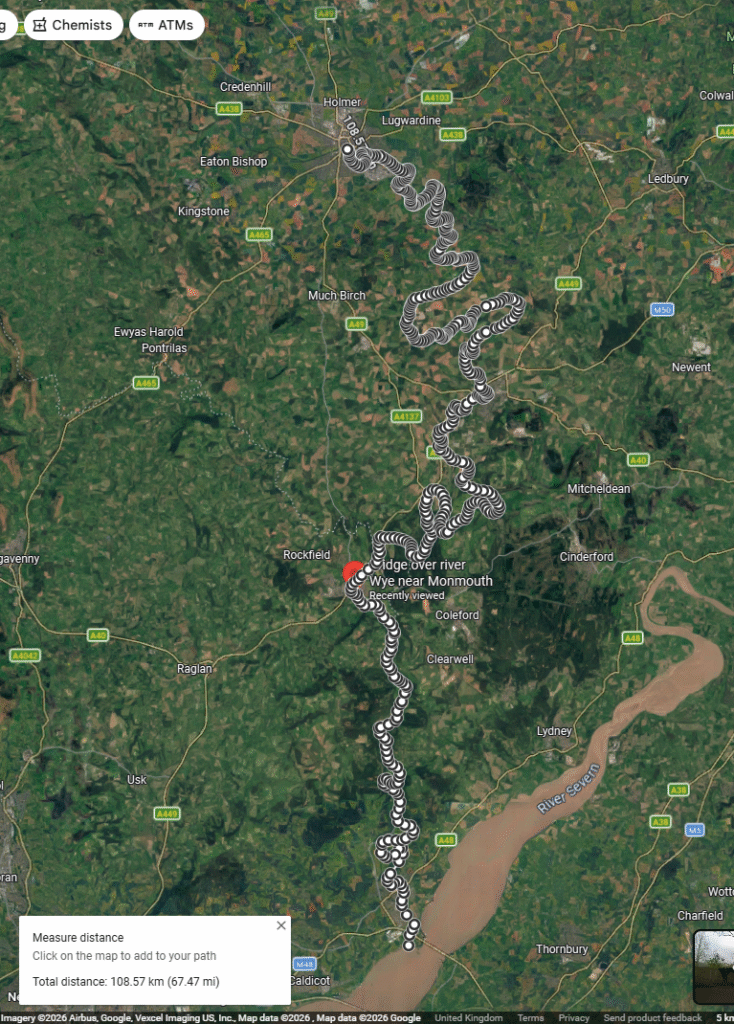
While looking at the potential for the Vikings to travel up the River Wye to Hereford, I decided to measure the distance of the river from where it joins the River Severn to Hereford.
Only after completing this task did I realised that due to erosion and sedimentation, the River has most likely changed course in the last 1000 years.
References:
[ref 1] River Wye levels at Hereford: River Wye level at Old Wye Bridge – GOV.UK
[ref 2] AD Mills, Place Name Cictionary: Hereford – Oxford Reference
[ref 3] Old-English definitions of ‘army’: Old English had two words for “army”, those being “fyrd” and “here”. After the military reforms of K… – Robert | Rattibha
[ref 4] Definition of ‘here’ Old English Vocabulary: Your First 700 Words | Colin Gorrie and Old English Online
[ref 5] Descriptions and definitions of fyrd: Fyrd – Wikipedia and The Anglo-Saxon Fyrd – Historical Britain Blog and Regia Anglorum – The Fyrd (Army) in Anglo-Saxon England – Part 2
[ref 6] All old OS maps and LIDAR imagery: Georeferenced Maps viewer – Map images – National Library of Scotland
[ref 7] Anglo-Saxon archaeological discoveries in Hereford: Herefordshire Through Time – Welcome
[ref 8] Anglo-Saxon Chronicles [pdf], page 80: The Anglo-Saxon Chronicle
[ref 9] Roman archaeological discoveries in Hereford: Herefordshire Through Time – Welcome
[ref 10] Annales Cambriae [pdf], page 63: https://ia801401.us.archive.org/11/items/annalescambriae00willgoog/annalescambriae00willgoog.pdf
[ref 11] Louis from Austrailia, comment connecting Burford with Hereford: Henffordd – Welsh / General / Questions – SSi Forum and definition of ‘byr’ byr in English – Welsh-English Dictionary | Glosbe
[ref 12] Map showing extent of Offa’s Dyke: The extent and course of Offa’s Dyke and Wat’s Dyke as understood in… | Download Scientific Diagram
[ref 13] Ergyng independence group: WHERE ARE WE? | ergyng
[ref 14] Hedgehog ring: Vervel from “The Land of the Hedgehog” – Detecting Finds and GLO-F83E32, Post Medieval silver vervel from Herefordshire, County of | Portable Antiquities Scheme
[ref 15] Old English pronunciation, from 06:39 – 14:42: Old English Pronunciation: A Comprehensive Reconstruction
Finally, I would like to extend a huge thanks to my Mum for all her help. While I can’t reference anything she’s specifically said, and she will also attest to doing nothing, being able to bounce ideas off someone with a knowledge of the history of the time period has been invaluable. She has also provided the motivation to ensure that this page doesn’t remain a draft.
Is it possible that the current spelling is due to a spelling mistake? Like how surnames can have many different spellings. They likely started with one, but over time more variations came about. Could Hereford just be a spelling mistake?